


Understanding Tesla Charging Cost and Saving Tips in the US
Did you know electric vehicles can cut your fuel costs by over 60%? This change is huge for our daily budgets in the United States.
When I bought my electric car, I learned fast about the Tesla charging cost. It’s key for saving money. Figuring out utility rates and public station fees can be tough. Transparency is key for saving and driving smart.
My experience shows small changes can save a lot each month. I want to share these tips to help you manage your energy costs. By following these strategies, you’ll control your car’s power needs and save money.
Key Takeaways
- Electric vehicles offer substantial savings on fuel compared to internal combustion engines.
- Monitoring your home utility rates is the most effective way to lower expenses.
- Public stations often carry premium fees that impact your overall budget.
- Off-peak hours provide the best value for replenishing your battery at home.
- Strategic planning helps you avoid unnecessary spending during long road trips.
What is Tesla Charging Cost?
Understanding the cost of electric vehicle ownership starts with knowing your energy expenses. When I look at the Tesla charging cost, I consider the total electricity cost for daily driving.
Knowing these costs helps me budget better. It’s key to understand the different ways to charge your car. Each method has its own price.
Breakdown of Charging Expenses
Charging at home is usually the cheapest option. It depends on your local utility rate. This is often the most affordable choice for owners.
On the other hand, commercial stations like Superchargers charge more. They offer convenience and speed, but it costs more. This affects the cost of charging a Tesla on long trips.
Factors Influencing Costs
Several things affect your monthly cost. The biggest factor is your car’s battery size. Bigger batteries need more energy to fully charge.
Local utility rates also play a big role in EV charging expenses. Electricity costs vary across the United States. They depend on demand and local energy policies.
Lastly, charging efficiency is a hidden factor. Not all energy from the grid goes into the battery. Understanding these losses helps me estimate the true cost of charging a Tesla over time.
Types of Tesla Charging Options
Choosing how to charge my Tesla is a big decision. I can charge at home or use public stations. The choice affects how much I spend on electricity.
Home Charging Solutions
Most owners charge at home with a wall connector in the garage. Charging Tesla at home cost is usually cheaper. I charge overnight, so my car is ready for the next day.
Convenience is the biggest plus of this method. I just plug in when I get home. This keeps my charging Tesla at home cost steady, unlike public stations.
Supercharging Stations
For long trips, I use public Supercharger stations. They charge fast, but Tesla supercharger fees are higher. These Tesla charging station costs are for convenience on the road.
“The true value of an electric vehicle lies in the ability to fuel up where you live, while the public network provides the freedom to explore anywhere.”
I see these stations as a travel perk, not a daily need. By using both home and public charging, I save money. Knowing about Tesla supercharger fees helps me travel far without breaking the bank.
Average Charging Costs Across the US
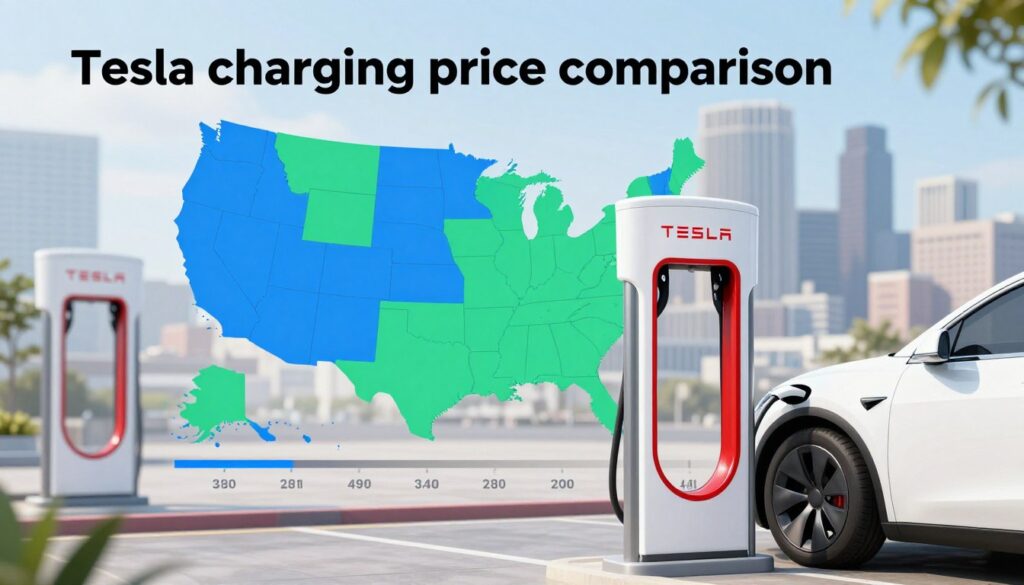
Geography plays a big role in your Tesla charging price comparison. The cost per kilowatt-hour (kWh) changes based on your local utility and state rules. This means two drivers with the same habits can pay very different amounts each month for EV charging expenses.
Regional Differences in Pricing
Electricity rates vary across the United States. Places like Washington and Idaho have low rates thanks to hydroelectric power. But, states like California and Massachusetts have higher bills due to infrastructure and demand.
Knowing your local utility’s rates can help you understand your EV charging expenses better. Just check their website for details.
Comparing Urban vs. Rural Costs
Urban and rural areas have different charging costs. Cities have more Superchargers, which can lead to lower prices. But, high demand can cause peak-hour surcharges, raising your costs.
Rural areas often have fewer charging options and higher rates. While you might avoid city traffic, your bills could be higher. Here’s how these factors affect your Tesla charging price comparison in different places.
| Region Type | Typical Rate Factor | Infrastructure Density | Cost Impact |
|---|---|---|---|
| Urban Center | High Demand | Very High | Moderate to High |
| Suburban Area | Balanced | Moderate | Low to Moderate |
| Rural Location | Limited Choice | Low | Stable but Higher |
Charging Costs by Tesla Model
The cost of charging a Tesla changes a lot based on the car model. Each model has a different battery size and efficiency. So, I need to look at these details to compare the Tesla charging prices accurately.
Model S Charging Costs
The Model S has a big battery for its range and power. This means it needs more electricity to fill up than smaller models.
Charging a Model S costs more per session because of its big battery. But, its drivetrain is efficient, which helps lower costs on long drives.
Model 3 Charging Costs
The Tesla Model 3 charging cost is often the lowest in the lineup. It’s made to be very efficient, so I can go further on less energy.
The Model 3 is also light and aerodynamic, which helps keep costs down. I usually see lower bills when I charge it at home.
Model X Charging Costs
The Model X is a big SUV, which means it uses more energy than sedans. Its size and weight require more power for the same range as the Model 3.
Even though charging costs more, the Model X’s benefits make it worth it. I plan my budget with this in mind.
| Tesla Model | Battery Size | Efficiency Level |
|---|---|---|
| Model 3 | Standard/Long Range | High |
| Model S | Long Range/Plaid | Medium-High |
| Model X | Long Range/Plaid | Medium |
How to Calculate Your Charging Cost
Understanding how much power my car needs helps me save money every month. By tracking energy use, I can estimate my costs accurately. This way, I can manage my Tesla charging cost and stay within my budget.
Energy Consumption Rates
To figure out your costs, first check your car’s efficiency in kWh per 100 miles. Most electric cars, like the Tesla Model 3, show this on the dashboard. Multiply your miles by your efficiency rate to find the energy needed for your trips.
After finding the total kWh, multiply it by your local utility rate. For instance, if your Tesla Model 3 charging cost is $0.15 per kWh, you can estimate your weekly expenses. Keeping a log of your miles and charging sessions is the best way to get accurate results.
“The most effective way to lower your transportation expenses is to treat your vehicle’s energy consumption like any other household utility bill.”
Pricing Plans Explained
It’s key to understand electric vehicle charging rates because utility companies have complex billing. Many offer Time-of-Use (TOU) plans with changing prices. Always check your local utility website for discounts on off-peak hours.
The table below shows how efficiency levels affect your monthly costs at a rate of $0.14 per kWh for 1,000 miles.
| Vehicle Efficiency (kWh/100mi) | Total kWh Needed | Estimated Monthly Cost |
|---|---|---|
| 25 kWh | 250 kWh | $35.00 |
| 30 kWh | 300 kWh | $42.00 |
| 35 kWh | 350 kWh | $49.00 |
By comparing these electric vehicle charging rates, you can see how small changes save a lot. Always check your utility bill every few months to find the best plan for you.
Finding Tesla Supercharger Locations
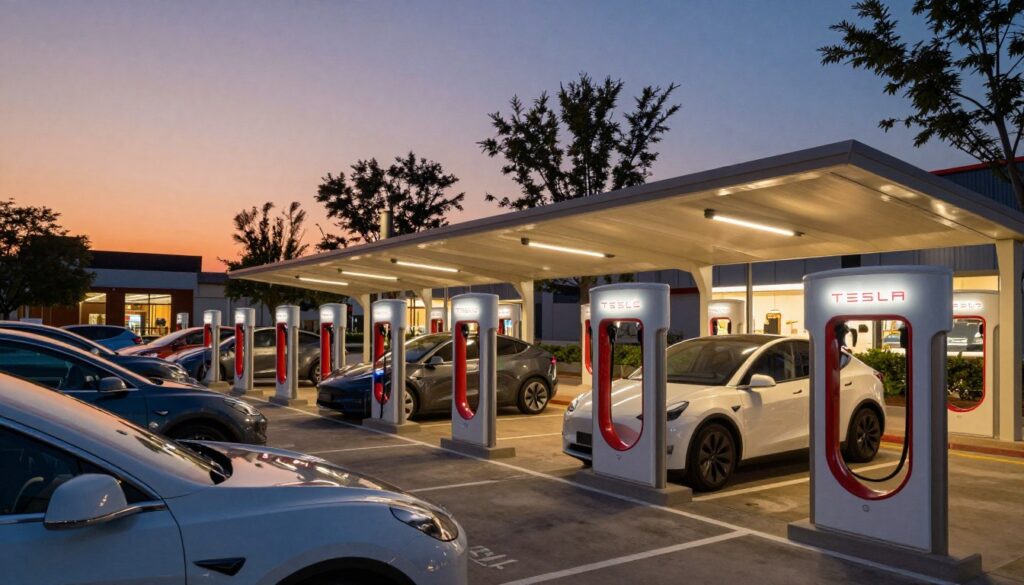
I use digital tools to find the best charging spots and save money. It’s important to have the right tools to manage Tesla charging station costs. This way, I can travel across the country without worrying about my budget.
Using the Tesla App
The Tesla app is my go-to for planning routes and managing energy. It gives me real-time updates on charging station availability. This helps me avoid long waits or high prices.
I can filter stations by power output and how busy they are. This helps me avoid Tesla supercharger fees for waiting or high demand. The app ensures I pick the best route for my car.
“Effective route planning is the cornerstone of electric vehicle ownership, turning range anxiety into a smooth journey.”
Maps and Online Resources
I also check third-party maps and websites for more information. These sites offer insights on Tesla charging station costs that might not be on standard maps. This helps me find the best places to charge and save money.
Comparing data helps me keep track of Tesla supercharger fees in different areas. Below is a table showing the tools I use to charge affordably and efficiently.
| Tool Name | Primary Benefit | Cost Tracking |
|---|---|---|
| Tesla Official App | Real-time availability | High accuracy |
| PlugShare | Community reviews | Moderate detail |
| A Better Routeplanner | Advanced trip routing | Excellent estimation |
Tips for Reducing Charging Costs
As a Tesla owner, I’ve tried many ways to keep my charging costs down. It’s all about smart scheduling and using financial programs. By changing my routine, my monthly bills have dropped a lot.
Off-Peak Charging Benefits
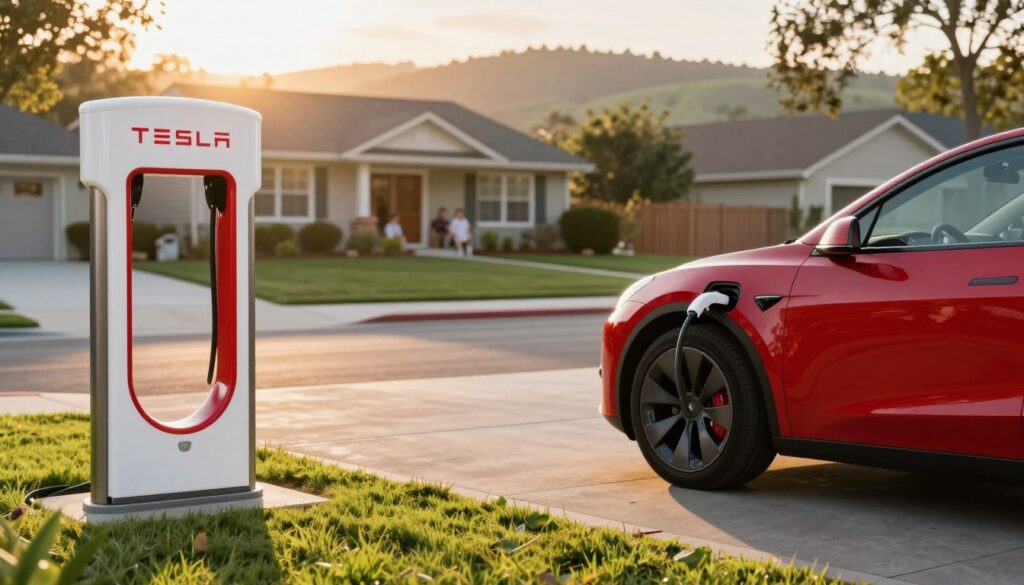
Shifting my charging to off-peak hours made a big difference. Utility companies often charge less at night when it’s quiet. Setting my car to charge then saves me money.
I use the Tesla app to schedule my charging. This way, my car is ready for the morning without waking me up. It’s a smart way to save money and keep my car charged.
Incentives and Discounts
I’ve also looked into government incentives and utility discounts. Many places offer tax credits or rebates for home charging setups. These help make the initial cost of a wall connector more affordable.
It’s also wise to check with your local utility for EV plans. Some offer special rates for electric car owners. Looking into these options has really helped my budget.
Understanding Utility Rates and EV Plans
Understanding electricity billing is key for Tesla owners to save money. Utility companies have different pricing that can affect your budget. Knowing these structures helps you control your electric vehicle charging rates and save on every mile.
Time-of-Use Plans
Many utilities offer Time-of-Use (TOU) plans. These plans change the cost of electricity based on the time of day. Prices are higher during peak hours and lower during off-peak hours.
It’s best to charge your Tesla during off-peak hours. These times are usually late at night or early morning. This way, you can drastically reduce your monthly expenses without changing your driving habits.
Special EV Rates Offered by Utilities
Some utilities have special EV rates for plug-in vehicle owners. These rates are lower for home charging. Some even offer rebates for installing a dedicated Level 2 charger.
I’ve made a table to help you see how different plans affect your wallet. Knowing these differences is the first step to optimizing your energy consumption.
| Rate Plan Type | Primary Benefit | Best For |
|---|---|---|
| Flat Rate | Predictability | Low-mileage drivers |
| Time-of-Use (TOU) | Lower off-peak costs | Night-time chargers |
| EV-Specific Plan | Reduced per-kWh pricing | High-mileage commuters |
| Demand Charge | Grid stability | Commercial users |
Choosing the right plan depends on your daily routine and energy needs. Contact your utility provider to see if they have an EV-specific rate. This ensures you’re not missing out on savings while supporting a greener future.
The Environmental Impact of Tesla Charging
Looking beyond the tailpipe is key to understanding the full impact of charging a Tesla. Electric vehicles don’t emit emissions while driving. But, the environmental cost of charging depends on the power grid. My charging habits are tied to the energy mix from my local utility.
Sustainable Energy Sources
The move toward a greener grid is speeding up as more states invest in renewable energy. Charging my vehicle with power from wind, solar, or hydroelectric sources boosts environmental benefits. Many utility providers offer green energy programs for home charging stations.
By picking these programs, I cut down the carbon intensity of my driving. This is a critical part of making transportation sustainable in the U.S. Even with a mix of energy sources, electric motors are more efficient than gas engines.
Carbon Footprint Considerations
The carbon footprint of a Tesla changes based on the local energy mix. In places where coal is a main source, the environmental benefit is smaller but there’s a difference. As the grid evolves, the long-term carbon savings of electric vehicles will grow.
Comparing energy sources shows how my charging choices affect the environment. The table below shows the impact of different power generation methods on electric vehicle carbon footprints.
| Energy Source | Carbon Intensity | Sustainability Rating |
|---|---|---|
| Solar/Wind | Very Low | Excellent |
| Hydroelectric | Low | High |
| Natural Gas | Moderate | Average |
| Coal | High | Low |
The cumulative effect of more electric vehicles will push for cleaner energy. By joining this effort, I help reduce our national dependence on fossil fuels. My daily charging is a small but important step toward a sustainable transformation.
Future Trends in Tesla Charging Costs
The future of electric vehicle charging is set to change a lot. In the next few years, how we charge our cars in the United States will see big changes.
Predictions for 2025 and Beyond
Utility companies are spending a lot on making the grid better for electric cars. They want to keep energy prices stable when demand is high. I think Tesla owners will soon get to pay less for charging during off-peak hours thanks to smart grids.
The Role of Advancements in Charging Technology
New tech will help make charging cheaper in the long run. Faster charging means less time waiting at stations. This makes charging stations work better and saves money for everyone.
Keeping up with these tech improvements will help you get the most out of your electric car. It’s all part of moving towards a future where cars run on electricity.
FAQ
What is the typical Tesla charging cost for a full battery at home?
The cost to charge a Tesla at home varies based on your local electricity rate. On average, charging a Tesla Model 3 with a 60 kWh battery costs about .60 if you pay
FAQ
What is the typical Tesla charging cost for a full battery at home?
The cost to charge a Tesla at home varies based on your local electricity rate. On average, charging a Tesla Model 3 with a 60 kWh battery costs about $9.60 if you pay $0.16 per kWh. Using off-peak hours can make charging much cheaper.
How do Tesla supercharger fees compare to residential electricity rates?
Tesla supercharger fees are higher than home rates because of the convenience and maintenance of high-speed charging. While home charging costs $0.16 per kWh, Supercharger stations charge between $0.30 and $0.50 per kWh. This can double your EV charging costs on road trips, but the speed is worth it for long trips.
Why do electric vehicle charging rates vary so much by region?
The biggest factor in pricing is where you are. For example, states with lots of hydroelectric power like Washington or Idaho have lower rates. But, states like Massachusetts or California have some of the highest costs. Urban areas often have higher rates, while rural areas have lower rates but fewer charging options.
What is the average Tesla Model 3 charging cost for a daily commute?
For my daily commute, charging my Tesla Model 3 is very affordable. Driving 30 miles a day uses about 8 to 9 kWh of energy, costing less than $1.50 a day. This is much cheaper than a standard sedan, saving over $1,000 a year on fuel.
How can I accurately calculate the cost of charging a Tesla based on my utility bill?
To find the exact cost of charging a Tesla, look at your latest utility bill. Find the price per kWh, including taxes and fees. Then, multiply that by your vehicle’s battery capacity (e.g., 100 kWh for a Model S). Remember, there’s a 10-15% loss in charging efficiency.
Are there ways to lower my monthly EV charging expenses?
Yes, I’ve cut my EV charging costs by switching to a Time-of-Use (TOU) plan. Many utilities offer special rates for charging between midnight and 6:00 AM. I also use the Tesla App to schedule my charging to avoid expensive peak hours.
How do battery sizes affect the Tesla charging price comparison between models?
The size of the battery is the main factor in charging costs. A Tesla Model X with a 100 kWh battery costs more to fill than a Standard Range Model 3. But, the Model 3 is more efficient, making it cheaper per mile.
Where can I find the most current information on Tesla charging station costs?
I use the Tesla App and in-car navigation for real-time data on Supercharger fees and availability. For other options, I check PlugShare or ChargePoint to find good rates at places like hotels or shopping centers.
What trends should I expect for electric vehicle charging rates in 2025?
By 2025, I expect electric vehicle charging rates to stabilize as the grid modernizes. I predict more “V4” Supercharger deployments and more renewable energy. While costs may drop, understanding your local utility’s EV plans will be key to managing your charging costs.
.16 per kWh. Using off-peak hours can make charging much cheaper.
How do Tesla supercharger fees compare to residential electricity rates?
Tesla supercharger fees are higher than home rates because of the convenience and maintenance of high-speed charging. While home charging costs
FAQ
What is the typical Tesla charging cost for a full battery at home?
The cost to charge a Tesla at home varies based on your local electricity rate. On average, charging a Tesla Model 3 with a 60 kWh battery costs about $9.60 if you pay $0.16 per kWh. Using off-peak hours can make charging much cheaper.
How do Tesla supercharger fees compare to residential electricity rates?
Tesla supercharger fees are higher than home rates because of the convenience and maintenance of high-speed charging. While home charging costs $0.16 per kWh, Supercharger stations charge between $0.30 and $0.50 per kWh. This can double your EV charging costs on road trips, but the speed is worth it for long trips.
Why do electric vehicle charging rates vary so much by region?
The biggest factor in pricing is where you are. For example, states with lots of hydroelectric power like Washington or Idaho have lower rates. But, states like Massachusetts or California have some of the highest costs. Urban areas often have higher rates, while rural areas have lower rates but fewer charging options.
What is the average Tesla Model 3 charging cost for a daily commute?
For my daily commute, charging my Tesla Model 3 is very affordable. Driving 30 miles a day uses about 8 to 9 kWh of energy, costing less than $1.50 a day. This is much cheaper than a standard sedan, saving over $1,000 a year on fuel.
How can I accurately calculate the cost of charging a Tesla based on my utility bill?
To find the exact cost of charging a Tesla, look at your latest utility bill. Find the price per kWh, including taxes and fees. Then, multiply that by your vehicle’s battery capacity (e.g., 100 kWh for a Model S). Remember, there’s a 10-15% loss in charging efficiency.
Are there ways to lower my monthly EV charging expenses?
Yes, I’ve cut my EV charging costs by switching to a Time-of-Use (TOU) plan. Many utilities offer special rates for charging between midnight and 6:00 AM. I also use the Tesla App to schedule my charging to avoid expensive peak hours.
How do battery sizes affect the Tesla charging price comparison between models?
The size of the battery is the main factor in charging costs. A Tesla Model X with a 100 kWh battery costs more to fill than a Standard Range Model 3. But, the Model 3 is more efficient, making it cheaper per mile.
Where can I find the most current information on Tesla charging station costs?
I use the Tesla App and in-car navigation for real-time data on Supercharger fees and availability. For other options, I check PlugShare or ChargePoint to find good rates at places like hotels or shopping centers.
What trends should I expect for electric vehicle charging rates in 2025?
By 2025, I expect electric vehicle charging rates to stabilize as the grid modernizes. I predict more “V4” Supercharger deployments and more renewable energy. While costs may drop, understanding your local utility’s EV plans will be key to managing your charging costs.
.16 per kWh, Supercharger stations charge between
FAQ
What is the typical Tesla charging cost for a full battery at home?
The cost to charge a Tesla at home varies based on your local electricity rate. On average, charging a Tesla Model 3 with a 60 kWh battery costs about $9.60 if you pay $0.16 per kWh. Using off-peak hours can make charging much cheaper.
How do Tesla supercharger fees compare to residential electricity rates?
Tesla supercharger fees are higher than home rates because of the convenience and maintenance of high-speed charging. While home charging costs $0.16 per kWh, Supercharger stations charge between $0.30 and $0.50 per kWh. This can double your EV charging costs on road trips, but the speed is worth it for long trips.
Why do electric vehicle charging rates vary so much by region?
The biggest factor in pricing is where you are. For example, states with lots of hydroelectric power like Washington or Idaho have lower rates. But, states like Massachusetts or California have some of the highest costs. Urban areas often have higher rates, while rural areas have lower rates but fewer charging options.
What is the average Tesla Model 3 charging cost for a daily commute?
For my daily commute, charging my Tesla Model 3 is very affordable. Driving 30 miles a day uses about 8 to 9 kWh of energy, costing less than $1.50 a day. This is much cheaper than a standard sedan, saving over $1,000 a year on fuel.
How can I accurately calculate the cost of charging a Tesla based on my utility bill?
To find the exact cost of charging a Tesla, look at your latest utility bill. Find the price per kWh, including taxes and fees. Then, multiply that by your vehicle’s battery capacity (e.g., 100 kWh for a Model S). Remember, there’s a 10-15% loss in charging efficiency.
Are there ways to lower my monthly EV charging expenses?
Yes, I’ve cut my EV charging costs by switching to a Time-of-Use (TOU) plan. Many utilities offer special rates for charging between midnight and 6:00 AM. I also use the Tesla App to schedule my charging to avoid expensive peak hours.
How do battery sizes affect the Tesla charging price comparison between models?
The size of the battery is the main factor in charging costs. A Tesla Model X with a 100 kWh battery costs more to fill than a Standard Range Model 3. But, the Model 3 is more efficient, making it cheaper per mile.
Where can I find the most current information on Tesla charging station costs?
I use the Tesla App and in-car navigation for real-time data on Supercharger fees and availability. For other options, I check PlugShare or ChargePoint to find good rates at places like hotels or shopping centers.
What trends should I expect for electric vehicle charging rates in 2025?
By 2025, I expect electric vehicle charging rates to stabilize as the grid modernizes. I predict more “V4” Supercharger deployments and more renewable energy. While costs may drop, understanding your local utility’s EV plans will be key to managing your charging costs.
.30 and
FAQ
What is the typical Tesla charging cost for a full battery at home?
The cost to charge a Tesla at home varies based on your local electricity rate. On average, charging a Tesla Model 3 with a 60 kWh battery costs about $9.60 if you pay $0.16 per kWh. Using off-peak hours can make charging much cheaper.
How do Tesla supercharger fees compare to residential electricity rates?
Tesla supercharger fees are higher than home rates because of the convenience and maintenance of high-speed charging. While home charging costs $0.16 per kWh, Supercharger stations charge between $0.30 and $0.50 per kWh. This can double your EV charging costs on road trips, but the speed is worth it for long trips.
Why do electric vehicle charging rates vary so much by region?
The biggest factor in pricing is where you are. For example, states with lots of hydroelectric power like Washington or Idaho have lower rates. But, states like Massachusetts or California have some of the highest costs. Urban areas often have higher rates, while rural areas have lower rates but fewer charging options.
What is the average Tesla Model 3 charging cost for a daily commute?
For my daily commute, charging my Tesla Model 3 is very affordable. Driving 30 miles a day uses about 8 to 9 kWh of energy, costing less than $1.50 a day. This is much cheaper than a standard sedan, saving over $1,000 a year on fuel.
How can I accurately calculate the cost of charging a Tesla based on my utility bill?
To find the exact cost of charging a Tesla, look at your latest utility bill. Find the price per kWh, including taxes and fees. Then, multiply that by your vehicle’s battery capacity (e.g., 100 kWh for a Model S). Remember, there’s a 10-15% loss in charging efficiency.
Are there ways to lower my monthly EV charging expenses?
Yes, I’ve cut my EV charging costs by switching to a Time-of-Use (TOU) plan. Many utilities offer special rates for charging between midnight and 6:00 AM. I also use the Tesla App to schedule my charging to avoid expensive peak hours.
How do battery sizes affect the Tesla charging price comparison between models?
The size of the battery is the main factor in charging costs. A Tesla Model X with a 100 kWh battery costs more to fill than a Standard Range Model 3. But, the Model 3 is more efficient, making it cheaper per mile.
Where can I find the most current information on Tesla charging station costs?
I use the Tesla App and in-car navigation for real-time data on Supercharger fees and availability. For other options, I check PlugShare or ChargePoint to find good rates at places like hotels or shopping centers.
What trends should I expect for electric vehicle charging rates in 2025?
By 2025, I expect electric vehicle charging rates to stabilize as the grid modernizes. I predict more “V4” Supercharger deployments and more renewable energy. While costs may drop, understanding your local utility’s EV plans will be key to managing your charging costs.
.50 per kWh. This can double your EV charging costs on road trips, but the speed is worth it for long trips.
Why do electric vehicle charging rates vary so much by region?
The biggest factor in pricing is where you are. For example, states with lots of hydroelectric power like Washington or Idaho have lower rates. But, states like Massachusetts or California have some of the highest costs. Urban areas often have higher rates, while rural areas have lower rates but fewer charging options.
What is the average Tesla Model 3 charging cost for a daily commute?
For my daily commute, charging my Tesla Model 3 is very affordable. Driving 30 miles a day uses about 8 to 9 kWh of energy, costing less than
FAQ
What is the typical Tesla charging cost for a full battery at home?
The cost to charge a Tesla at home varies based on your local electricity rate. On average, charging a Tesla Model 3 with a 60 kWh battery costs about $9.60 if you pay $0.16 per kWh. Using off-peak hours can make charging much cheaper.
How do Tesla supercharger fees compare to residential electricity rates?
Tesla supercharger fees are higher than home rates because of the convenience and maintenance of high-speed charging. While home charging costs $0.16 per kWh, Supercharger stations charge between $0.30 and $0.50 per kWh. This can double your EV charging costs on road trips, but the speed is worth it for long trips.
Why do electric vehicle charging rates vary so much by region?
The biggest factor in pricing is where you are. For example, states with lots of hydroelectric power like Washington or Idaho have lower rates. But, states like Massachusetts or California have some of the highest costs. Urban areas often have higher rates, while rural areas have lower rates but fewer charging options.
What is the average Tesla Model 3 charging cost for a daily commute?
For my daily commute, charging my Tesla Model 3 is very affordable. Driving 30 miles a day uses about 8 to 9 kWh of energy, costing less than $1.50 a day. This is much cheaper than a standard sedan, saving over $1,000 a year on fuel.
How can I accurately calculate the cost of charging a Tesla based on my utility bill?
To find the exact cost of charging a Tesla, look at your latest utility bill. Find the price per kWh, including taxes and fees. Then, multiply that by your vehicle’s battery capacity (e.g., 100 kWh for a Model S). Remember, there’s a 10-15% loss in charging efficiency.
Are there ways to lower my monthly EV charging expenses?
Yes, I’ve cut my EV charging costs by switching to a Time-of-Use (TOU) plan. Many utilities offer special rates for charging between midnight and 6:00 AM. I also use the Tesla App to schedule my charging to avoid expensive peak hours.
How do battery sizes affect the Tesla charging price comparison between models?
The size of the battery is the main factor in charging costs. A Tesla Model X with a 100 kWh battery costs more to fill than a Standard Range Model 3. But, the Model 3 is more efficient, making it cheaper per mile.
Where can I find the most current information on Tesla charging station costs?
I use the Tesla App and in-car navigation for real-time data on Supercharger fees and availability. For other options, I check PlugShare or ChargePoint to find good rates at places like hotels or shopping centers.
What trends should I expect for electric vehicle charging rates in 2025?
By 2025, I expect electric vehicle charging rates to stabilize as the grid modernizes. I predict more “V4” Supercharger deployments and more renewable energy. While costs may drop, understanding your local utility’s EV plans will be key to managing your charging costs.
.50 a day. This is much cheaper than a standard sedan, saving over
FAQ
What is the typical Tesla charging cost for a full battery at home?
The cost to charge a Tesla at home varies based on your local electricity rate. On average, charging a Tesla Model 3 with a 60 kWh battery costs about $9.60 if you pay $0.16 per kWh. Using off-peak hours can make charging much cheaper.
How do Tesla supercharger fees compare to residential electricity rates?
Tesla supercharger fees are higher than home rates because of the convenience and maintenance of high-speed charging. While home charging costs $0.16 per kWh, Supercharger stations charge between $0.30 and $0.50 per kWh. This can double your EV charging costs on road trips, but the speed is worth it for long trips.
Why do electric vehicle charging rates vary so much by region?
The biggest factor in pricing is where you are. For example, states with lots of hydroelectric power like Washington or Idaho have lower rates. But, states like Massachusetts or California have some of the highest costs. Urban areas often have higher rates, while rural areas have lower rates but fewer charging options.
What is the average Tesla Model 3 charging cost for a daily commute?
For my daily commute, charging my Tesla Model 3 is very affordable. Driving 30 miles a day uses about 8 to 9 kWh of energy, costing less than $1.50 a day. This is much cheaper than a standard sedan, saving over $1,000 a year on fuel.
How can I accurately calculate the cost of charging a Tesla based on my utility bill?
To find the exact cost of charging a Tesla, look at your latest utility bill. Find the price per kWh, including taxes and fees. Then, multiply that by your vehicle’s battery capacity (e.g., 100 kWh for a Model S). Remember, there’s a 10-15% loss in charging efficiency.
Are there ways to lower my monthly EV charging expenses?
Yes, I’ve cut my EV charging costs by switching to a Time-of-Use (TOU) plan. Many utilities offer special rates for charging between midnight and 6:00 AM. I also use the Tesla App to schedule my charging to avoid expensive peak hours.
How do battery sizes affect the Tesla charging price comparison between models?
The size of the battery is the main factor in charging costs. A Tesla Model X with a 100 kWh battery costs more to fill than a Standard Range Model 3. But, the Model 3 is more efficient, making it cheaper per mile.
Where can I find the most current information on Tesla charging station costs?
I use the Tesla App and in-car navigation for real-time data on Supercharger fees and availability. For other options, I check PlugShare or ChargePoint to find good rates at places like hotels or shopping centers.
What trends should I expect for electric vehicle charging rates in 2025?
By 2025, I expect electric vehicle charging rates to stabilize as the grid modernizes. I predict more “V4” Supercharger deployments and more renewable energy. While costs may drop, understanding your local utility’s EV plans will be key to managing your charging costs.
,000 a year on fuel.
How can I accurately calculate the cost of charging a Tesla based on my utility bill?
To find the exact cost of charging a Tesla, look at your latest utility bill. Find the price per kWh, including taxes and fees. Then, multiply that by your vehicle’s battery capacity (e.g., 100 kWh for a Model S). Remember, there’s a 10-15% loss in charging efficiency.
Are there ways to lower my monthly EV charging expenses?
Yes, I’ve cut my EV charging costs by switching to a Time-of-Use (TOU) plan. Many utilities offer special rates for charging between midnight and 6:00 AM. I also use the Tesla App to schedule my charging to avoid expensive peak hours.
How do battery sizes affect the Tesla charging price comparison between models?
The size of the battery is the main factor in charging costs. A Tesla Model X with a 100 kWh battery costs more to fill than a Standard Range Model 3. But, the Model 3 is more efficient, making it cheaper per mile.
Where can I find the most current information on Tesla charging station costs?
I use the Tesla App and in-car navigation for real-time data on Supercharger fees and availability. For other options, I check PlugShare or ChargePoint to find good rates at places like hotels or shopping centers.
What trends should I expect for electric vehicle charging rates in 2025?
By 2025, I expect electric vehicle charging rates to stabilize as the grid modernizes. I predict more “V4” Supercharger deployments and more renewable energy. While costs may drop, understanding your local utility’s EV plans will be key to managing your charging costs.

Hi! I’m Moheen Iftikhar, the creator of «CarPulseMedia» I’m passionate about exploring the latest car trends, automotive technology, and driving tips to help you stay informed and inspired. I share expert guides, car reviews, and practical advice for every auto enthusiast.