



Mercedes EV battery life insights I rely on every day
Driving my luxury electric vehicle has changed my life. I’ve learned that proactive maintenance is key to keeping it running well.
Understanding my Mercedes power system has changed my daily travel. Simple, consistent habits keep my vehicle in top shape for years.
I aim to make owning an EV easier for others. This guide shares how I protect my battery and extend its life. I focus on smart charging and mindful usage.
Key Takeaways
- Prioritize consistent charging habits to maintain long-term capacity.
- Avoid extreme temperatures to protect internal components.
- Monitor your vehicle’s health through the official mobile application.
- Use regenerative braking to reduce mechanical wear and tear.
- Schedule regular software updates to optimize energy management systems.
Understanding the Mercedes-Benz Battery Management System
Every time I drive my Mercedes-Benz, a silent digital guardian works behind the scenes to protect my battery. This system, known as the Battery Management System (BMS), is the brain of every EQ model. It constantly checks data to keep my vehicle efficient and reliable for years.
How the BMS protects your EQS and EQE cells
The BMS watches over each battery cell. It tracks voltage levels in real-time to avoid overcharging or deep discharging. This careful control is key to keeping the EQ series battery health strong.
If it spots an imbalance, the system fixes it by adjusting energy flow. This keeps all cells working well together. I feel safe knowing these protections are always on while I drive.
The role of thermal management in daily operation
The car also has a smart EV thermal management system to control temperature. Batteries work best in a certain temperature range. The car keeps them there, no matter the weather.
This smart system stops the battery from getting too hot or cold. It keeps the cells in their ideal operating zone. This means I get consistent performance every time I drive.
The table below shows how these systems work together to keep the car running well.
| Feature | Primary Function | Benefit to Owner |
|---|---|---|
| Cell Balancing | Equalizes voltage across all modules | Maximizes total capacity |
| Thermal Regulation | Maintains optimal temperature range | Extends overall battery lifespan |
| Overcharge Protection | Limits energy intake at high states | Prevents chemical stress |
| Deep Discharge Guard | Prevents voltage from dropping too low | Ensures reliable start-up |
Mastering Mercedes EV battery life through daily charging habits
Managing my Mercedes EV battery life is all about being consistent and smart with charging. How I treat my battery every day affects its performance over time. By being disciplined, I keep my vehicle efficient and reliable for years.
Establishing a consistent charging routine at home
Charging at home is my top choice because it gives me more control. Following home EV charging best practices helps keep the battery at the right temperature. This is gentler than the fast charging at public stations. These Mercedes-Benz charging tips are key to my experience.
To keep the battery healthy, I follow a set schedule that matches my daily driving. Here are the main habits I use to support EV battery longevity:
- Plug in the vehicle as soon as I return home for a slow, steady charge.
- Use the MBUX interface to schedule charging during off-peak hours when electricity demand is lower.
- Keep the charging cable organized and protected from extreme weather conditions.
Avoiding the pitfalls of frequent 100 percent charges
One key lesson I’ve learned is to avoid 100 percent charges unless I’m going on a long trip. Charging to full for too long stresses the battery’s internal chemistry. I charge to 80 percent for my daily commute to keep the cells healthy.
Consistency is truly the key to avoiding early wear. Limiting the battery’s charge helps prevent it from sitting in a high-voltage state. This simple change has helped keep my Mercedes-Benz’s range strong.
The impact of extreme temperatures on EQ series performance
When it’s very cold or hot, your Mercedes-Benz EQ needs special care. This is to keep the battery working well. By focusing on battery degradation prevention, I help my car stay in top shape for years.

Pre-conditioning your vehicle during winter months
Cold weather makes the battery work harder, which can cut down on range. I use the pre-conditioning feature to warm the battery while it’s charging at home. This proactive approach makes sure the battery is ready to go when I start driving.
Using energy from the grid instead of the battery helps keep it strong. This simple habit is key to EV thermal management in winter. It keeps the car cozy and protects the battery from too much stress.
Mitigating heat stress on the battery during summer driving
Too much heat is as tough as cold for lithium-ion batteries. In summer, I’m careful where I park my car. I choose shaded spots or garages to keep the battery cool.
If I have to park in the sun, I start the cabin cooling through MBUX while it’s charging. This helps keep the battery at a good temperature. Paying attention to these details is vital for keeping the battery healthy and the car running well.
Why I prioritize the 20 to 80 percent state of charge rule
Keeping my Mercedes-Benz battery in a certain energy range helps it last longer. By focusing on lithium-ion battery maintenance, I keep my car reliable for years. Staying within the 20 to 80 percent range is key to avoiding damage.

The chemistry behind the sweet spot for lithium-ion longevity
Lithium-ion cells face the most stress when fully charged or completely drained. At 100 percent, the high voltage causes chemical instability in the electrolyte. This can lead to faster capacity loss over time.
On the other hand, letting the battery drop to zero percent can cause internal resistance to spike. By keeping it between 20 to 80 percent, I ensure the ions stay stable. This prevents the structural fatigue that occurs at the extreme ends of the charge spectrum.
Practical ways to set charge limits in the MBUX interface
Setting your vehicle to stop charging automatically is easy. You can manage these MBUX battery settings through the central touchscreen in your Mercedes-Benz.
Here’s how to protect your investment:
- Navigate to the “Charging” menu on your MBUX display.
- Select the “Charge Program” or “Settings” tab.
- Locate the “Maximum Charge Level” slider.
- Adjust the limit to 80 percent for your daily routine.
This simple adjustment ensures your car stops drawing power once it reaches the ideal threshold. It’s a proactive approach that benefits your battery’s long-term health.
| Charge Range | Battery Stress Level | Recommended Use |
|---|---|---|
| 0% – 20% | High (Risk of deep discharge) | Avoid for daily parking |
| 20% – 80% | Low (Optimal stability) | Ideal for daily driving |
| 80% – 100% | High (Chemical stress) | Use only for long trips |
Utilizing regenerative braking to extend range and longevity
Learning to use regenerative braking has changed how I drive my Mercedes-Benz EQ. It captures energy when I slow down. This boosts EV battery longevity and regenerative braking efficiency.
Every stop becomes a chance to recharge the battery. This makes driving more efficient.

Adjusting recuperation levels for city versus highway driving
The MBUX interface lets me control how the car slows down. In city traffic, I choose a high recuperation level. This makes one-pedal driving easier and captures more energy.
On the highway, I use a lower setting or coasting mode. This helps with Mercedes EQ range optimization. It keeps the car moving without wasting energy.
Reducing mechanical brake wear through intelligent energy recovery
This feature also protects my car’s parts. The electric motor does most of the braking. This means the brakes wear out less.
So, I save money on brake repairs. It’s a smart way to keep my car in top shape.
| Driving Scenario | Recuperation Level | Primary Benefit |
|---|---|---|
| Heavy City Traffic | High / Strong | Maximum Energy Recovery |
| Highway Cruising | Low / Standard | Improved Coasting Efficiency |
| Mountain Descents | Maximum | Controlled Speed & Charging |
Using these features makes driving smoother and more fun. It’s easy to adjust settings for better performance. This way, I get the most out of my electric vehicle.
Software updates and their role in battery health optimization
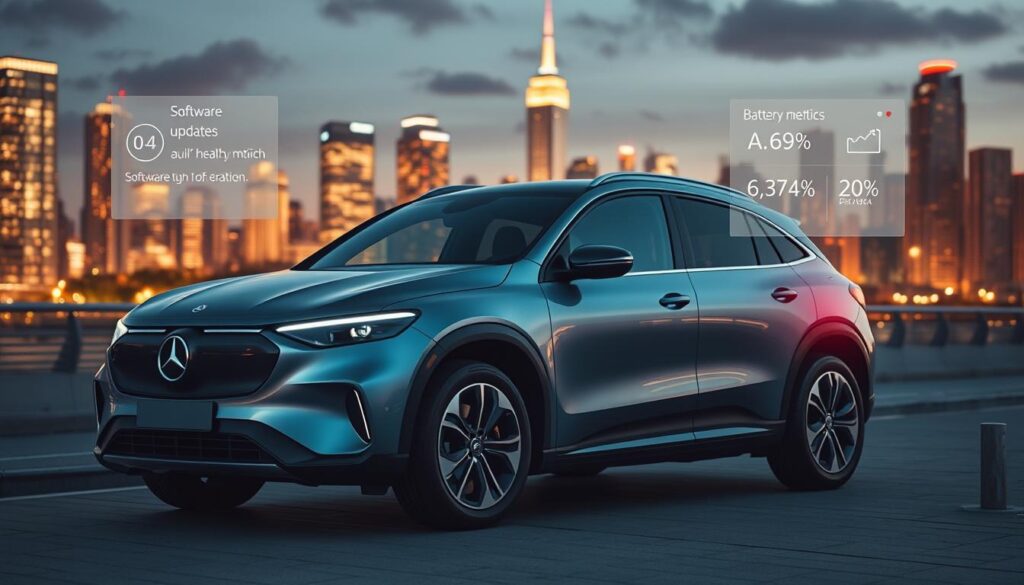
The life of my battery depends on code as much as on how I charge it. Electric vehicles are like smart computers. Digital updates affect how well they work. Keeping my car’s software up to date helps it run at its best.
Over-the-air updates that improve energy efficiency
Mercedes-Benz sends updates that make my car’s battery work better. These updates are key for Mercedes EQ range optimization. They help my car use less energy.
These updates often make my car more efficient. It’s like getting a small boost in performance.
“Technology is best when it brings people together and makes our lives more efficient through constant, thoughtful improvement.”
Why I never skip a Mercedes-Benz service campaign
I always go to the dealership for service campaigns. These updates can’t be sent remotely. Ignoring these notifications could harm my battery’s health.
Going for these updates keeps my car’s software current. This helps my car stay efficient. It also keeps my battery safe.
Managing long-term storage for your Mercedes-Benz EQ
When I store my Mercedes-Benz EQ for weeks, I stick to a strict maintenance plan. The right preparation keeps your luxury EV in top shape during downtime. A few proactive steps can prevent early battery wear.

Best practices for leaving your vehicle parked for extended periods
The place where you park your car is very important. I always try to park in a climate-controlled garage. Heat or cold can damage the car even when it’s not moving.
Also, turn off any services you don’t need if the car will be parked for over a month. This stops the battery from draining too much. Regular lithium-ion battery maintenance helps your car be ready to go when you are.
“The longevity of an electric vehicle battery is largely determined by how it is treated during periods of inactivity. Stability is the key to preserving chemical integrity.”
Maintaining the ideal charge level for battery preservation
Keeping the battery state of charge right is key for long storage. I never charge my car to 100 percent or let it drop to zero. Both can harm the battery’s internal chemistry.
I try to keep the charge between 40 and 60 percent before parking for a long time. This range helps avoid damage to the battery. If you’re parking for months, check the charge level to keep it in this safe range.
| Storage Factor | Recommended Action | Benefit |
|---|---|---|
| Charge Level | 40% to 60% | Prevents cell stress |
| Environment | Climate-controlled | Reduces thermal degradation |
| Connectivity | Minimize usage | Protects 12V battery |
By following these simple steps, you protect your investment and ensure your Mercedes-Benz EQ performs exactly as expected upon your return. Proper battery state of charge management is a small effort that yields significant long-term rewards for your vehicle’s health.
Decoding the Mercedes-Benz battery warranty and health reports
Knowing what my vehicle’s warranty covers gives me peace of mind. It’s important to understand how to track its health. This knowledge helps ensure my car runs well for a long time.
What the manufacturer warranty actually covers
The Mercedes-Benz battery warranty protects my investment. It promises the battery will hold a certain percentage of its original power for a set time or miles.
I check my owner’s manual to know the warranty’s details. Proper maintenance and following charging tips are key to keeping the warranty active.
Interpreting battery health data via the Mercedes me connect app
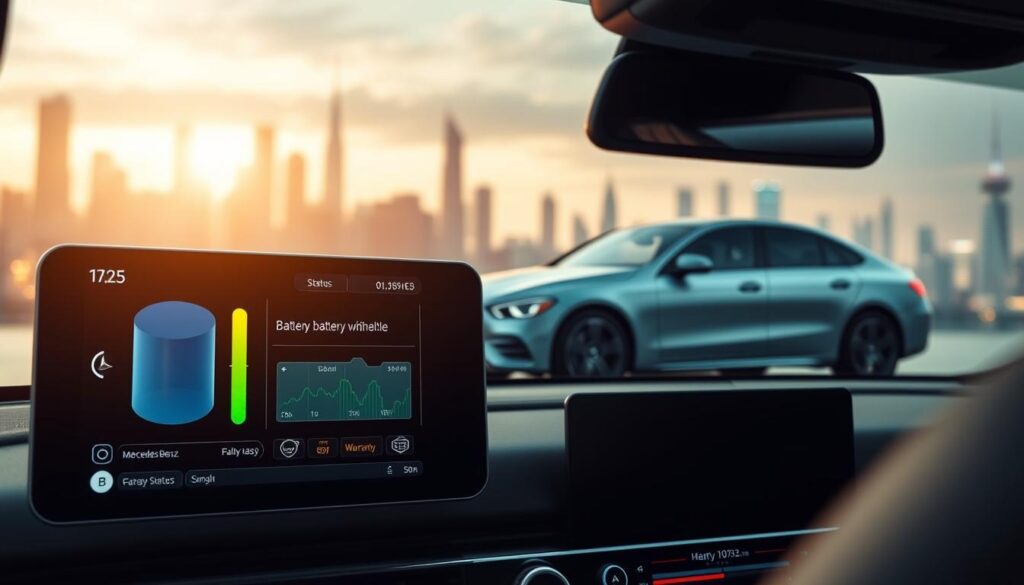
Keeping an eye on my EQ series battery health is easy with the Mercedes me connect app. It gives me updates on my battery’s condition in real-time.
I often use the app to see how charged my battery is and its overall health. This helps me spot any problems early on.
By understanding this data, I can drive and charge my car better. It helps me keep my Mercedes-Benz battery warranty in effect and enjoy my electric vehicle fully.
The difference between AC home charging and DC fast charging
Charging your electric vehicle has two main methods. These methods affect your battery differently. Knowing these Mercedes-Benz charging tips helps keep your vehicle running well for years.
Alternating Current (AC) charging is common for home use. It gives a steady flow of energy. On the other hand, Direct Current (DC) fast charging sends high-voltage power straight to the battery. It’s great for long trips but needs careful use.
When to use Wallbox chargers versus public fast-charging stations
I suggest using a home Wallbox for daily charging. This follows home EV charging best practices. It lets the battery charge slowly while you sleep.
Public fast-charging stations are best for long trips or quick charges. Using them too much can stress your battery. This is because they charge quickly and can get very hot.
Minimizing the degradation effects of high-voltage DC charging
To prevent battery damage, I limit DC fast charging. When I do use it, I charge up to 80 percent. Charging beyond that can cause more heat and stress.
Knowing the DC fast charging impact is key for long-term vehicle health. Using AC charging for daily needs helps keep your battery healthy. This way, your Mercedes-Benz stays efficient for years.
Essential accessories and tools for monitoring battery health
Keeping your Mercedes-Benz EV in top shape is all about data-driven maintenance. By monitoring your car’s health closely, you can keep your battery in great condition for years. I use a mix of built-in software and external tools to stay updated on my car’s performance.
Using the MBUX system to track energy consumption trends
The MBUX system is more than just for navigation and media. I often check the MBUX battery settings to see how my energy use changes. It shows me how driving and climate control affect my range.
By looking at these trends, I can spot ways to use less energy. If my energy use suddenly goes up, I know it’s time to change my driving or check my tires. Consistency is key for keeping your battery lasting longer.
“Knowledge is the first step toward mastery, specially with our modern electric vehicles.”
Third-party diagnostic tools for the dedicated Mercedes owner
For deeper insights, Mercedes battery diagnostic tools offer a closer look at cell health. These tools connect to the OBD-II port to get detailed data not shown on the dashboard. I use them to check cell voltages and temperature changes during charging.
The table below shows the difference between basic monitoring and detailed diagnostics:
| Feature | MBUX System | Diagnostic Tool |
|---|---|---|
| Data Depth | User-friendly trends | Raw cell-level data |
| Accessibility | Built-in interface | External hardware |
| Primary Use | Daily efficiency | Long-term health |
These Mercedes battery diagnostic tools help me catch early signs of battery wear. The MBUX system is great for daily tweaks, but these tools give me peace of mind. Make sure any third-party device is compatible with your car model to avoid software issues.
Conclusion
Owning a Mercedes-Benz EQ model means you’re all in on advanced engineering and green luxury. My own journey shows that keeping your battery healthy is all about being proactive, not just sitting back.
You have the power to make your lithium-ion cells last longer with just a few simple steps. Making small tweaks to how you use energy can make a big difference for your car’s future.
Take some time to check out the settings in your MBUX interface. It can help you understand how you drive and make choices that keep your car running well.
Electric driving should be fun and worry-free. By following these care tips, your Mercedes-Benz will be a trusted friend for years to come.
Let’s share our stories with each other. Talking about our experiences can help us all learn more about these amazing cars.
FAQ
How does the Battery Management System (BMS) in my Mercedes-Benz EQS ensure long-term reliability?
The BMS is like the brain of my car. It watches over each cell’s voltage and temperature. This stops overcharging or deep discharging.
It keeps the battery in the best range, even in bad weather. This protects my EQS or EQE’s battery health.
Why do I avoid charging my Mercedes-Benz EQ to 100 percent for daily use?
Charging to 100 percent too often can stress the battery. I only do it for long trips. At home, I use the Mercedes-Benz Wallbox to keep the battery between 20 and 80 percent.
This helps keep the battery healthy for a long time.
How can I minimize battery degradation during extreme summer or winter temperatures?
I use the pre-conditioning feature. It warms or cools the battery while it’s plugged in. This saves energy and keeps the battery healthy in cold or hot weather.
What is the most effective way to set charge limits in my vehicle?
I set a custom maximum charge level through MBUX. Limiting daily charges to 80 percent helps the battery last longer. This keeps the battery in good shape for years.
How does regenerative braking impact my driving range and battery life?
Adjusting the recuperation levels helps recover energy. This extends my range in city driving. It also reduces brake wear, making driving more efficient.
Why are over-the-air (OTA) updates critical for my Mercedes EV battery life?
I never miss a Mercedes-Benz service campaign or OTA update. They improve energy efficiency. These updates help the BMS manage power better, keeping my car efficient.
What steps should I take if I need to leave my Mercedes-Benz EQ parked for an extended period?
Before long storage, I charge the battery to about 50 percent. I park in a climate-controlled garage. Adjusting connectivity settings helps protect the battery from temperature changes.
How can I monitor the actual health and performance of my battery?
I check the Mercedes me connect app for battery health reports. For more details, I analyze energy use in MBUX or use third-party tools. This helps spot any changes in cell health or performance.
What is the difference between using a home Wallbox and a DC fast-charging station?
DC fast charging is good for long trips but can degrade the battery. I use it sparingly. For daily driving, I prefer an AC Wallbox. It charges slower but is gentler on the battery.
What does the Mercedes-Benz battery warranty actually cover for my vehicle?
The warranty covers significant capacity loss or technical issues in the battery. By following service intervals and keeping software up to date, I keep the warranty valid. This also helps maintain my car’s value.

Hi! I’m Moheen Iftikhar, the creator of «CarPulseMedia» I’m passionate about exploring the latest car trends, automotive technology, and driving tips to help you stay informed and inspired. I share expert guides, car reviews, and practical advice for every auto enthusiast.